


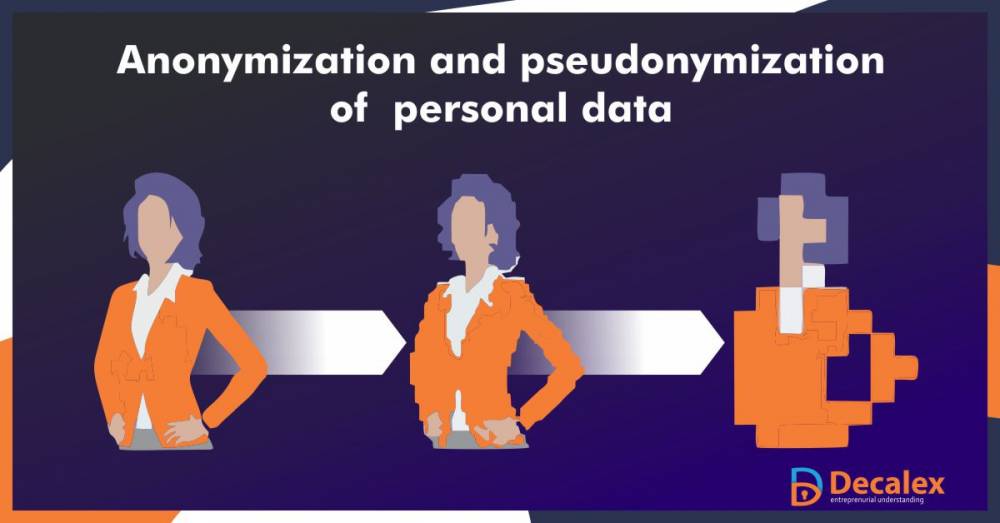
Anonymisation and pseudonymisation are two techniques frequently confused, with entirely different legal effects. One permanently eliminates GDPR applicability, the other reduces it partially. This article clarifies the differences, illustrates available techniques, and explains when and how each should be applied in organisational practice.
The anonymisation of personal data involves a process of modifying the data, so that it becomes impossible to identify the person to whom that data refers, either directly or indirectly. Thus, anonymous data loses the quality of personal data. As the principles of data protection apply to any information relating to an identified or identifiable natural person, they will not apply to anonymous information, i.e. information which is not related to an identified or identifiable natural person or personal data which is thus anonymised. so that the data subject is not or is no longer identifiable.
Regulation (EU) 2016/679 of the European Parliament and of the Council of 27 April 2016 on the protection of natural persons with regard to the processing of personal data and on the free movement of such data, defines pseudonymisation as being „the processing of personal data in such a way that they can no longer be attributed to a specific data subject without using additional information, provided that such additional information is stored separately and is the subject of technical and organizational measures ensuring that the personal data concerned are not allocated to an identified or identifiable natural person.”
As pseudonymisation is a reversible process, pseudonymised data retains the character of personal data and the data protection legislation is still applicable to them.
The difference between the two processes is due to the possibility of identifying the data subject or not.
Regulation (EU) 2016/679 of the European Parliament and of the Council of 27 April 2016 on the protection of natural persons with regard to the processing of personal data and on the free movement of such data, regulates that when determining whether a person is identifiable or not „(…) all means should be taken into account, such as individualization, which are likely to be used either by the controller or another person for identification purposes, directly or indirectly, of the natural person concerned.”
If the source data has not been deleted at the time of anonymisation, the controller who keeps both the source data and the anonymised data will be able to identify the persons using the anonymised data. In this case, the anonymised data will continue to be treated as personal data, unless the anonymisation process would prevent the identification of the data subject, even for the holder of the source data.
As noted above, data may be considered anonymised when data subjects can no longer be identified, taking into account any methods that may reasonably be used by the controller to identify data subjects. In the event that the controller keeps any identification key or other information that can be used to make the anonymisation process reversible, the identification will be possible and the data will no longer be anonymized, thus remaining subject to legal data protection provisions.
The methods of anonymization can be varied but all aim to eliminate the information that makes it possible to identify the data subject.
Complete data deletion is one of the most powerful methods of data anonymization.
Data encryption is another effective anonymization method as long as the decryption key is permanently deleted once the encryption is complete.
Data masking is a way of anonymizing which involves preserving the structure of the data and which is done by encoding the data and replacing the characters in the personal data.
Pseudonymization can be achieved by replacing several identification fields in a data set with one or more identifiers such as codes, random symbols, etc., the purpose of pseudonymization being to increase the level of protection of personal data.
Thus, there are several pseudonymization techniques but it should be emphasized that it is necessary for controllers to ensure that the technical and organizational measures used guarantee the detachment of pseudonymous information from the key that allows the re-identification of the data subject.
The most commonly used pseudonymization techniques are (i) secret key encryption; (ii) code (hash) function; (iii) key coding function, the key being stored; (iv) key coding function, the key being deleted; (v) use of tokens.
In practice, various errors can occur in the use of data anonymization and pseudonymization processes, errors that can make the applicability of these tools inefficient.
For example, when we want to anonymize personal data, we need to make sure that the process is irreversible and that the identification elements do not remain in the database so as to make it possible to reconstruct the information.
The most common errors in the pseudonymization process involve the use of the same key in several databases. Controllers need to ensure that the ability to link multiple data sets is eliminated, and this can be done by using an algorithm and the fact that a single data subject will correspond to different pseudonymization attributes in different contexts.
Another common mistake is to keep the key with your pseudonymized data or keep the key in an insecure environment.
In conclusion, if your company wants to apply one of the two techniques, must bear in mind that the difference between anonymization and pseudonymization is that anonymization is an irreversible process, as opposed to pseudonymization that allows the reconstitution of personal data.
Understanding the relevant risks, responsibilities, and objectives provides the necessary perspective for setting priorities and strengthening organizational resilience
Understanding the implications for activities, processes, responsibilities, organizational objectives, and decisions is the foundation of an informed and sustainable approach.
Effective risk management requires clear responsibilities, appropriate processes, and monitoring mechanisms that are commensurate with the level of exposure.
Clear roles and coordination mechanisms contribute to the coherence and sustainability of decisions.
Regular assessments of processes, responsibilities, and control mechanisms provide the necessary foundation for strengthening organizational resilience and governance.