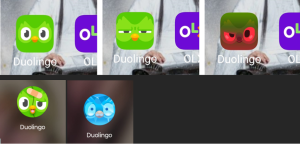
Have you ever thought that as a successful adult, member of a well-regarded company, or even its owner, you would find yourself under the thumb of an owl?
Duolingo is a digital platform initially focused on language learning. It has made a name for itself through its aggressive marketing strategy aimed at users. Considering that the app has at least 50 million daily active users globally, you will surely find yourself among them (or at least we will pique your curiosity) and you have experienced or will experience at least one notification saying, “Hey, I miss you. Log in to the app to do your lesson.”
This psychological pressure to be active and use the app’s resources is a notorious dark pattern of Duolingo. Dark patterns are design techniques used by online platform developers to get users to make decisions they wouldn’t otherwise make. These can include subtle psychological pressure (which in Duolingo’s case is anything but subtle), difficulty in quitting a service, and the use of emotions to increase engagement with the app.
Duolingo has a business model prone to excessive use of dark patterns. The app offers free access to most of its features: doing the lessons themselves, reading stories, and listening to podcasts. Certain benefits are associated with a premium account, such as unlimited energy, access to video call simulator lessons through artificial intelligence, and the almost complete elimination of ads.
If the user opts for the first level of premium subscription, Super Duolingo, they will only be able to completely remove third-party ads. To completely remove the app’s internal ads, a user must opt for the Duolingo Max subscription.
Thus, the Duolingo business model needs the highest possible user retention rate, because the app’s revenue is based on advertising revenue, the likelihood of a user purchasing a subscription, and their attachment to the app.
In this section, we will present some of the most notorious examples of dark patterns used by the app
The user is manipulated into setting certain features, such as enabling notifications, through questions such as: “Are you sure you want to risk losing your streak? Let Duo remind you! Enable your notifications!”
Through experience bonuses that can be activated by completing a lesson, the user is encouraged to use the app even more, with the experience doubling or tripling as long as the bonus is activated for a limited time.
The user’s experience of activating a certain feature of the app is obstructed by the multiple steps required to achieve that result. In this context, we are talking about a counterintuitive dark pattern of Duolingo, because in order to activate a free trial for a paid subscription to the app, no less than three steps must be taken.

Duolingo thus hides the cost of paid subscriptions, which can only be accessed by completing the six steps mentioned above.
Duolingo takes advantage of users’ habits by automatically enrolling them in competitive leagues, which encourages users to spend as much time as possible in the application. If the user loses access to a league, it can be purchased with diamonds.
Psychological pressure is also created through badges that can be earned by completing daily challenges. The more time the user spends in the app, the more difficult the challenges become, requiring more lessons to complete them.

To maintain the daily streak (which can now be added to LinkedIn to demonstrate engagement and consistency to profile visitors), the user is encouraged to spend diamonds. Also, to gain extra experience or maintain their place in the league, the user is encouraged to purchase diamonds.

In addition to the dark patterns presented, which can deceive and manipulate an adult, Duolingo has a specific interface based on bright colors, funny characters, interesting illustrations, and learning through play that can affect a child’s decision-making process. They can be much more easily drawn into making Duo feel better, can be much more easily motivated to spend diamonds to remain competitive in the leagues proposed by the app, and will likely spend much less time disabling certain roach motel-type features.

The main question remains whether this type of design with an emphasis on psychological pressure is acceptable if it has a positive outcome, namely learning. To the extent that users manage to maintain their streak, they actually learn more consistently, and a daily lesson, even one as short as 3 minutes, can create a habit and routine in learning a foreign language.
On the other hand, whether we are talking about a child or an adult, the effect created by DuoLingo is one of emotional manipulation, and the emphasis is on creating a habit, a streak, rather than on actual learning. Thus, users’ opinions are divided, with some considering the league system beneficial and motivating, while others consider it intrusive or putting unnecessary pressure on them.
Depending on how we choose to answer the previous question about Duolingo’s ethics, we can consider these dark patterns to be grey areas. However, beyond questions of ethics, or the nuance we choose to give it, dark or gray area, given that Duolingo is dedicated to both adults and children, we can easily say that the number of dark patterns is one of the highest on the market, the marketing is one of the most aggressive and intrusive, and a cute owl cannot justify the psychological pressure.
Oana Sîrbu
Junior Privacy & Data Protection Consultant