


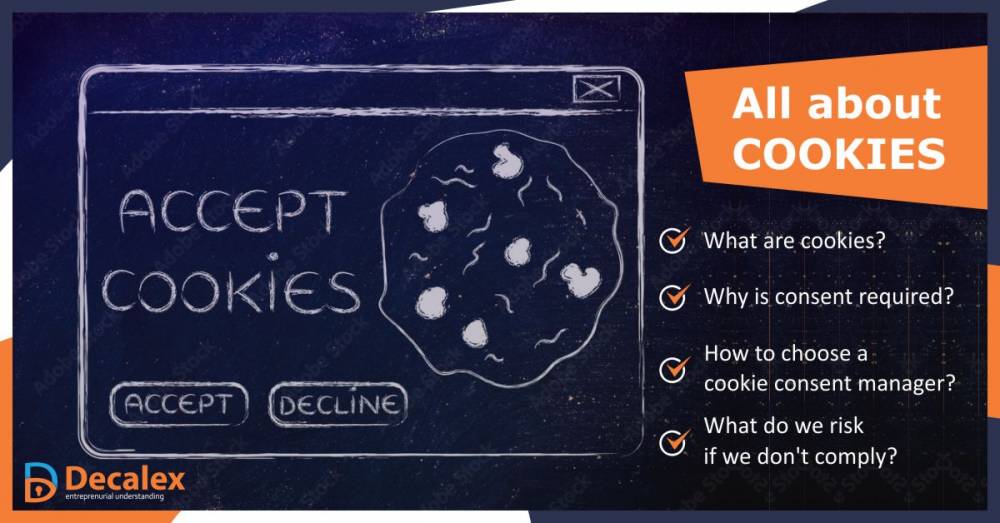
Cookie consent manager tools are the mechanism through which websites obtain valid consent for cookie placement. But not every cookie banner is GDPR-compliant. This article explains what makes a cookie consent manager truly compliant, what common mistakes to avoid, and how European authorities are enforcing cookie requirements.
Cookie consent manager tools are the utensils by which the user of a website is informed of the use of cookies and by which he or she is required to consent to placing them during online browsing on that website.
Cookies are small text files that can be used by websites to make their use more efficient. They are used to customize content and announcements, provide social networking functions and analyze traffic. Also, with their help, you provide social media partners advertising and analysis information on how you use the site.
The IP address (which represents personal data) is usually collected, or sometimes only the behavior of users.
Cookies themselves do not require personal information to be used and in most cases do not personally identify internet users. Personal data collected using cookies can only be collected to facilitate certain functionality for the user.
Consent does not need to be obtained for the use of necessary cookies, but for all other types, the user’s consent is required.
The rule is that a cookie consent manager script should be implemented if you use cookies on your website.
Cookies collect personal data (e.g., as mentioned above, IP address), and according to the GDPR, to be legal, processing must be based on a legal basis. In this case, the processing is lawful if the consent of the user has been obtained.
The legislative sources that cover this issue are the General Data Protection Regulation (GDPR) and the ePrivacy Directive.
First, there should be information to the user when cookies are used (“cookies consent bar”). This instrument shall comply with the following rules:
Failure to comply with the GDPR may result in fines of up to €20 million or 4% of your company’s overall turnover. The data Protection Authority may impose additional corrective measures, requiring you, for example, to stop processing personal data.
“NOYB” has sent 422 official complaints about cookies
NOYB announced on 10 August 2021 that it had sent 422 formal complaints about cookies to data protection authorities in ten countries. NOYB specifically pointed out that these necessary corrections involved the addition of a rejection option, the removal of pre-ticked boxes and the non-use of ‘legitimate interest’ as a legal basis. In addition, NOYB identified the need for a harmonized EU approach to cookie banners and underlined that it is now the duty of national supervisory authorities to examine complaints and enforce the law.
The European Data Protection Board establishes cookie banner taskforce
This taskforce was established in accordance with Art. 70 (1) (u) GDPR and aims to promote cooperation, information sharing and best practices between the SAs. In particular, the taskforce will:
National Supervisory Authorities publish guidelines on the use of cookies and consent request
On 10 June 2021, Garante (the Italian Data Processing Supervisory Authority) adopted a new version of its guidelines for cookies and other tracking technologies. The guide makes major changes to the guide previously provided by Garante. The key points in these guidelines are: Types of online markers and legal grounds; obtaining consent; reiteration of consent; about banners and the full policy that must be made available to users. The guide can be found here (in Italian and English lb.).
The Malta Supervisory Authority has published a short guide on the requirements for consent on cookies in order to help operators who use cookies in online services. The guide can be found here (in English lb.).
Sanctions applied
The French supervisory authority sanctioned a data operator with €50.000 because he placed third-party advertising cookies without the consent of the user and despite their refusal.
The Spanish Supervisory Authority sanctioned a data controller with €1.200 because the cookie tool used does not allow the user to refuse the activation of cookies and because the site did not contain an appropriate cookie policy. Another operator was also sanctioned with €2.000 for the same reasons.
Understanding the relevant risks, responsibilities, and objectives provides the necessary perspective for setting priorities and strengthening organizational resilience
Understanding the implications for activities, processes, responsibilities, organizational objectives, and decisions is the foundation of an informed and sustainable approach.
Effective risk management requires clear responsibilities, appropriate processes, and monitoring mechanisms that are commensurate with the level of exposure.
Clear roles and coordination mechanisms contribute to the coherence and sustainability of decisions.
Regular assessments of processes, responsibilities, and control mechanisms provide the necessary foundation for strengthening organizational resilience and governance.